You're feeding your bees.But are you getting
stronger, more
productive colonies?
Bees don't just need to eat — they need targeted nutrition that actually moves your operation forward:
- More brood
- A strong nurse population so the brood survives
- Maximum forager population at the exact timing you need them — to maximize your pollination service income
- A strong worker population for maximum honey production
And that's where other feeds fall short.
VitalBee delivers the full spectrum.
Most patties don't.
Sugar and crude protein keep a colony alive. But the nutrients that actually build strong, productive bees — balanced amino acids, lipids and sterols — are exactly what market-leading patties leave out.
| Ideal Pollen |
VitalBee Feed |
Market-Leading Pollen Patties |
|
|---|---|---|---|
| Protein | ✓ | ✓ | ✓ |
| Carbohydrates | ✓ | ✓ | ✓ |
| Honey bee essential amino acids10 de Groot EAAs | ✓ | ✓ | — |
| Lipidsomega-3 fatty acids | ✓ | ✓ | — |
| Sterolsphytosterols | ✓ | ✓ | — |
| Vitamins & minerals | ✓ | ✓ | — |
✓ Provided · — Little or none
Only VitalBee covers all six.
This is what strong nutrition looks like.
Seven nutrient systems, balanced the way a thriving colony actually uses them.
Amino Acids
Methionine, arginine, leucine, isoleucine, valine, lysine & threonine — building blocks bees can't make. Balance drives colony strength.
Healthy Fats
Balanced Omega 3:6 ratios that support cognitive function, longevity, brood rearing & hygienic behavior.
Sterols
Isofucosterol & 24-methylenecholesterol — bees can't make sterols; vital for membranes, molting & brood food.
Protein
Builds brood and the fat-bodied winter bees that carry the colony to spring.
Carbohydrates
Energy for flight, foraging & warming the winter cluster.
Minerals
Potassium, magnesium, calcium, zinc & iron — metabolism, nerve function & brood development.
Vitamins
B-complex (B1, B2, B3, B5, B6) & vitamin C — brood-rearing, gland development & metabolism.
What's noticeably different
in VitalBee-fed colonies.
Build
- Tighter, more uniform brood pattern — fewer missed cells.
- Population visibly ahead of schedule vs. standard-fed colonies.
- Colonies arrive at bloom already at contract strength — not still building.

Maintain
- Lower deadout rate through the pollination window.
- Forager activity holds strong mid-bloom — doesn't drop off as bloom progresses.
- Colonies that take a pesticide hit bounce back faster.

Recover
- Population decline is shallower and shorter — colonies rebuild faster.
- Colonies going into the next contract are visibly heavier and more populous.
- Stronger February colonies — the payoff of the full seasonal program.
Real colony results.
Field reports from named commercial operators and academic cooperators.
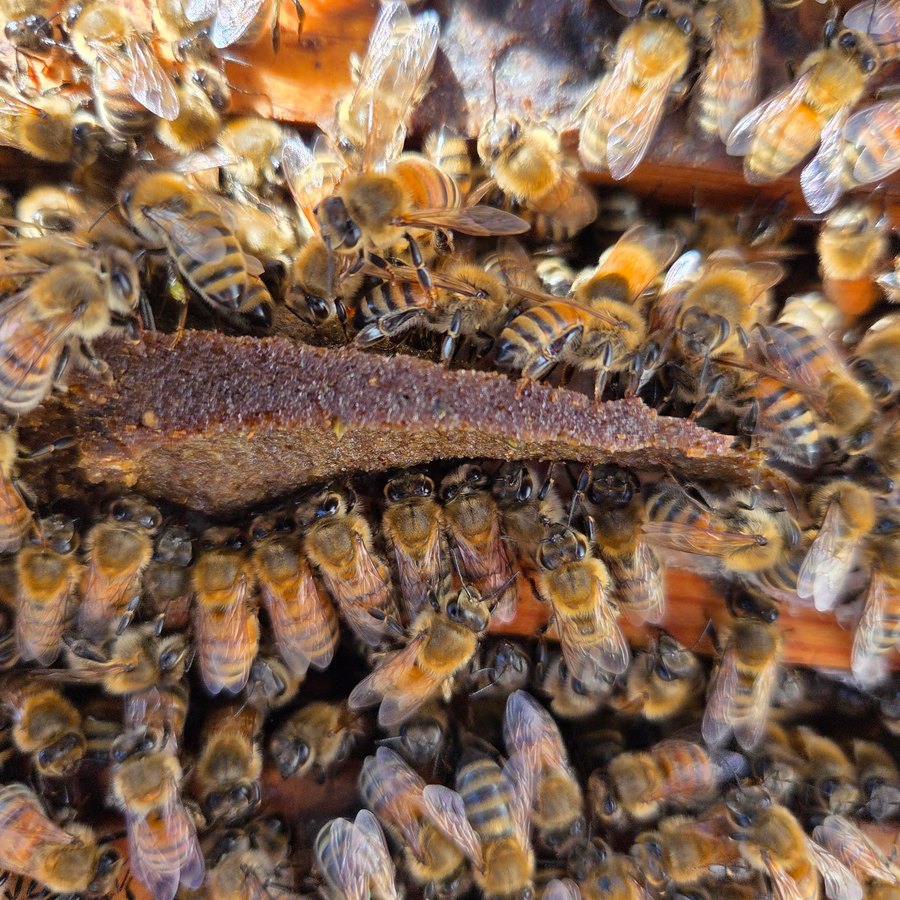
Nothing left after ten days — full pounds gone.
Gone in less than ten days. No waste.
Late season — and I'm seeing dramatic colony growth.
Populations did very well — even through significant weather variability. Strong brood, ready to split within weeks.
Side-by-side in VitalBee nucs · Spring 2026 · Hoopers Creek Bee Co. · Incidental finding under formal investigation.
We've proved it in our Bee Yards
Now prove it in yours.
- Massive populations
- Balanced cohorts of nurse bees, worker bees, and foragers
"You can see how much these bees love these patties."
Justin Brown — Founder
Run a side-by-side test in your own colonies
See the difference for yourself in:
- Consumption
- Brood development
- Colony performance